
HEMORRHAGIC SHOCK TREATMENT BY RAPID INFUSION PUMP
- May 7
- 5 min read
Mykola SHEVCHENKO
Major of the Medical Service
Senior Resident of the Department of Anesthesiology, Resuscitation and Intensive Medicine of the Zaporizhia Military Hospital
Natalia MOMOT, PHD
Leutenant of Medical Service
Leading Anesthesiologis of Medical Service and Sustainment Group “East”
Roman KUZIV
Lieutenant Colonel of the Medical Service
Commander of the Military Medical Clinical Center of the Eastern Region
Relevance of the Problem
Hemorrhagic shock is one of the main causes of death in military personnel at all stages of medical evacuation. Hemorrhagic shock treatment in the realities of current warfare remains a complex issue, despite the development of the modern medicine, the availability of blood components, and the ability to perform blood transfusion as close as possible to the line of contact.
Delays and increased evacuation distances, the severity of injuries, hypothermia, and many other factors significantly worsen the hemorrhagic shock progression and decrease survival chances. During the full-scale invasion in Ukraine, the concept of the “golden hour” in terms of the combat situation is no longer an achievable standard. The modern "war of drones" is not only causes significant evacuation delays but also forces Role 1 medical units to be set up farther from the line of contact. As a result, patients often arrive at Role 1 in a state of decompensated hemorrhagic shock.
Metabolic acidosis is the consequence of organ decompensation and decreased perfusion due to the massive blood loss. Along with hypothermia, which is an integral part of the evacuation of critically wounded, these conditions form a so-called “lethal triad” [1]. For this category of patients, the initiation of resuscitation timing and fluid temperature control are critically important. Under such conditions there is no time to use a water bath, and the only possible solution that provides instant heating of cold blood products is the usage of specialized infusion systems, such as the MEQU M Warmer, Ranger Blood Warming System, and others.
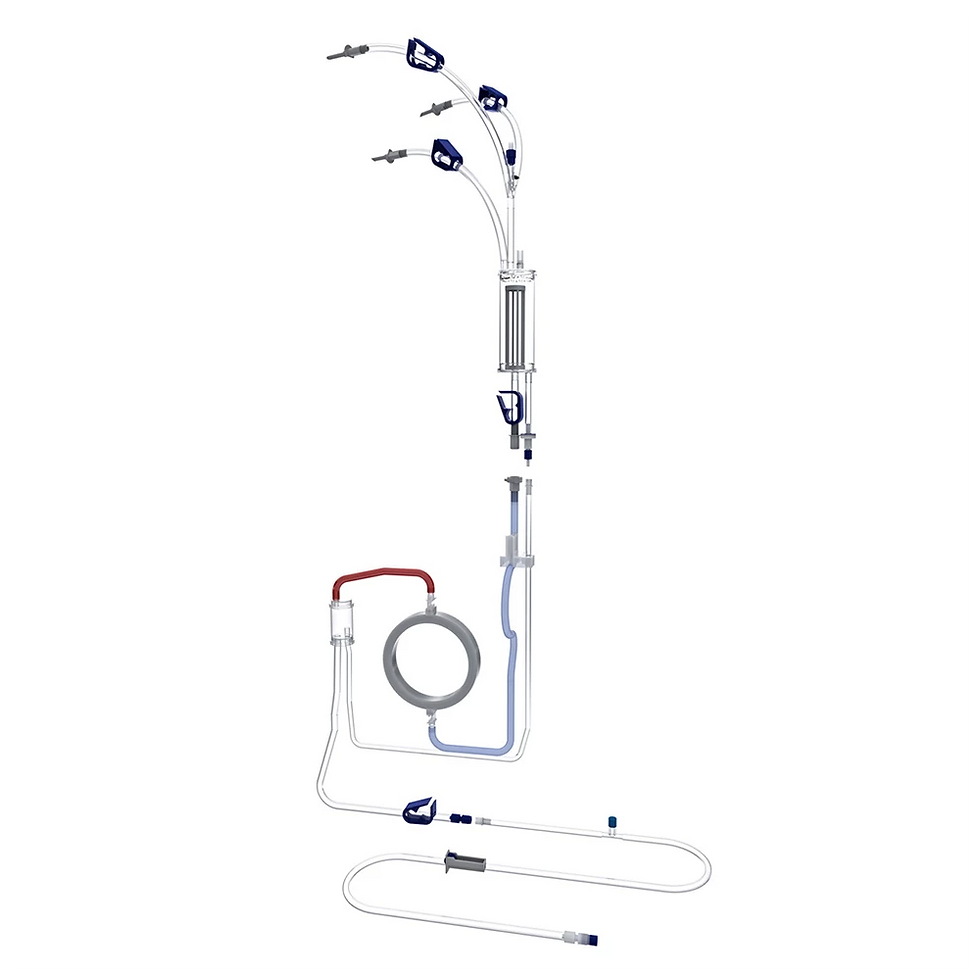
Belmont Rapid Infuser can be considered exceptional in comparison with its analogues. It not only provides instant heating of infusion solutions and complete system priming in less than 1 minute, but also achieves a fluid flow rate of up to 1000 ml/min, which makes it essential for saving patients’ lives with severe hemorrhagic shock. An additional advantage of the Belmont Rapid Infuser is the enhanced patients’ safety ensured by precise real-time control of infused volume and flow rate, automatic detection and air removal, as well as a flow regulation when system pressure exceeds 300 mmHg [3–5].
Zaporizhzhia Military Hospital has an experience of a successful usage of the Belmont Rapid Infuser at the stage of medical evacuation for patients with severe hemorrhagic shock in a state of decompensation. Below is an analysis of two clinical cases of severe blast injuries with Class III–IV hemorrhagic shock. In both cases were used a massive transfusion protocol 1:1:1 and a rapid infusion system.
Clinical Case 1
А- male, 29 years old
Т- 3 hours from the moment of injury
М- FPV-drone strike
І- multiple penetrating shrapnel wounds of the upper and lower extremities with an open fracture of the left lower leg bones, massive soft-tissue defect of the left thigh, and traumatic amputation of the right lower limb at the distal third of the thigh.
S- C-Tourniquet applied at the upper third of the thigh
А- Airway clear
В- RR 32/min, bilateral, Sp02=92%
C- BP 60/30 mmHg, Ps = 132/min
D- GCS 12 p.
Acid-Base Balance:
pH | pCO2 | pO2 | HCO3- | BE(ecf) | BE(b) | Lac | Na | K | Ca | Cl | Ht | Hb |
7.1 | 32 | 87 | -14.3 | -14.4 | -13.6 | 16.03 | 145 | 3.2 | 1.1 | 109 | 23 | 80 |
T- Care Provided:
1). Catheterization: Right subclavian vein with dual-lumen G16 and G18 catheters, right internal jugular vein G14 catheter, Urinary catheter, Nasogastric tube.
2). Anesthesia: Rapid sequence induction and intubation: ketamine 2 mg/kg + fentanyl 1 µg/kg + suxamethonium (ditilin) 2 mg/kg. Anesthesia support with Sodium oxybutyrate 70 mg/kg + fentanyl 0.1 µg/kg/min, Myoplegia with atracurium 0.5 mg/kg.
Initial vasopressor support by norepinephrine 1.2 µg/kg/min
Active warming with thermal blanket from the operating table side and external active warming by convection heating system.
Transfusion therapy: Iso-group and iso-Rh packed red blood cells and fresh frozen plasma: 6 + 6 units, Crystalloids: 1 liter of Sterofundin. Transfusion performed by a rapid infusion pump at a rate of 370 mL/min via G14 catheter.
Surgical intervention: Internal and external fixation of the left lower limb, tibia-foot segment, amputation of the right lower limb at the lower third of the thigh, wound debridement, hemostasis.
Pre-evacuation indicators: BP 120/70 mmHg, Ps 97/min, SpO₂ = 99%, Vasopressor support: norepinephrine 0.15 µg/kg/min
Clinical Case 2
А- male, 45 years old
Т- 5 hours from the moment of injury
М- Blast injury
І- multiple penetrating shrapnel wounds of the lower extremities with traumatic amputation of the left lower limb at the distal third of the thigh.
S- C-Tourniquet applied at the upper third of the thigh
А- Airway clear
В- Bilateral breathing, RR = 35/min, SpO₂ = 90%
C- BP = 50/20 mmHg, Ps = 145/min
D- GCS 10 p.
Acid-Base Balance:
pH | pCO2 | pO2 | HCO3- | BE(ecf) | BE(b) | Lac | Na | K | Ca | Cl | Ht | Hb |
6.9 | 29 | 19 | 5.1 | -28.5 | -26 | >20.00 | 134 | 4.5 | 0.7 | 109 | 16 | 54 |

T- Care Provided:
1). Catheterization: Right subclavian vein with dual-lumen G16 and G18 catheters, right internal jugular vein G14, Urinary catheter, Nasogastric tube
2). Anesthesia: Rapid sequence induction and intubation: ketamine 2 mg/kg + fentanyl 1 µg/kg + suxamethonium (ditilin) 2 mg/kg. Anesthesia support with sodium oxybutyrate 70 mg/kg + fentanyl 0.1 µg/kg/min. Myoplegia by atracurium 0.5 mg/kg
Initial vasopressor support: norepinephrine 1.8 µg/kg/min
Active warming with thermal blanket from the operating table side, and external active warming by a convection heating system.
Transfusion therapy: Iso-group and iso-Rh packed red blood cells and FFP: 7 + 7 units, Crystalloids: 1.5 liters of Sterofundin. Transfusion performed by a rapid infusion pump at a rate of 500 mL/min via a G14 catheter
Surgical intervention: Amputation of the left lower limb at the distal third of the thigh, wound debridement, Hemostasis.
Pre-evacuation indicators: BP 110/60 mmHg. Ps 109/min. SpO₂ = 99%, Vasopressor support: norepinephrine 0.12 µg/kg/min.
As demonstrated, the use of rapid infusion system for patients with hemorrhagic shock allowed for a fast and controlled warmed blood components infusion, which is critically important for hypovolemia correction, hypothermia, and following coagulopathy. The significant reduction in timing of the massive blood transfusion protocol led to hemodynamics improvement and a reduce the need for sympathomimetic support during anesthesia induction. Timely comprehensive care using a massive transfusion protocol allowed for stabilization of critically ill patients and their preparation for a safe transportation to the next stage of medical evacuation.
Conclusions
In the conditions of modern warfare, with a significant delay in providing medical care to critically wounded, an increasing number of casualties with hemorrhagic shock arrive at medical evacuation stages in a state of decompensation, which makes resuscitation time and temperature control of infusion fluid critically important.
The use of a rapid infusion pump makes it possible not only to correct hypovolemia as quickly as possible, but also to minimize the risks of hypothermia and coagulopathy [2].
When combined with a massive transfusion protocol in a 1:1:1 ratio, a rapid infusion pump contributes to the rapid hemodynamic stabilization and improves patient readiness for evacuation.
The use of the Belmont Rapid Infuser at the prehospital stages significantly increases survival chances in patients with severe hemorrhagic shock, when time is a decisive factor.
References
Stammers, A. H., Murdock, J. D., Klayman, M. H., Trowbridge, C., Yen, B. R., Franklin, D., & Elmore, J. (2005). Utilization of rapid-infuser devices for massive blood loss. Perfusion, 20(2), 65–69. https://doi.org/10.1191/0267659105pf787oa
Elmer, J., Wilcox, S. R., & Raja, A. S. (2013). Massive transfusion in traumatic shock. The Journal of emergency medicine, 44(4), 829–838. https://doi.org/10.1016/j.jemermed.2012.11.025
Azaris Medical. (n.d.). Belmont Rapid Infuser: technical specifications and product description. https://azaris.net.ua/ua/p2045747674-skorosnaya-infuzionnaya-pompa.html
Tactical Combat Casualty Care Ukraine (TCCC). (n.d.). Belmont Rapid Infuser RI-2: clinical guidance. https://tccc.org.ua/guide/belmont-rapid-infuser-ri-2
Belmont Medical Technologies. (n.d.). Rapid Infuser RI-2: disposable accessories and technical information. https://belmontmedtech.com/disposable-accessory-categories/rapid-infuser-ri-2

Comments